
Indirubin
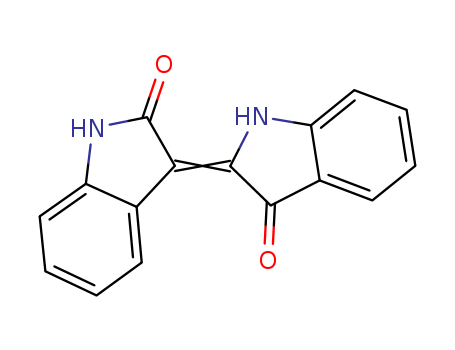
Base Information
- Chemical Name: Indirubin
- CAS No.: 479-41-4
Buy Good Quality Indirubin 479-41-4 with a minimum purity of 99%
- Molecular Formula: C16H10N2O2
- Molecular Weight: 262.268
- Appearance/Colour: Reddish-violet powder
- Vapor Pressure: 5.34E-10mmHg at 25°C
- Melting Point: 350°C(lit.)
- Refractive Index: 1.709
- Boiling Point: 496.6 °C at 760 mmHg
- PKA: 9.13±0.20(Predicted)
- Flash Point: 207 °C
- PSA: 58.20000
- Density: 1.417 g/cm3
- LogP: 2.93420
Indirubin(Cas 479-41-4) Usage
|
Physical properties |
Appearance: dark red acicular crystal with sublimate, odorless, and tasteless. Solubility: slightly soluble in dimethyl sulfoxide (DMSO) or tetrahydrofuran, very slightly soluble in chloroform or acetone, and insoluble in ethanol, ethyl ether, or water. Melting point: 348–353 °C. The stability of indirubin is poor that it needs to be stored away from light and thermal environment. |
|
History |
The report in 1951 showed that indirubin can inhibit eosinophils in the blood of guinea pigs. But this report did not attract attention. Indirubin is the effective component of the traditional Chinese medicine Angelica aloe pill. Since 1966, the scientists in the Institute of Hematonosis, Chinese Academy of Medical Sciences Research, started the research of therapying chronic myelocytic leukemia with the TCM rules using Angelica aloe pills, which had certain effect. Angelica aloe pill consisted of 11 herbs, such as Angelica, Aloe, Rhizoma Coptidis, and natural indigo. It was identified that natural indigo was the effective component of Angelica aloe pill. However, the active ingredient of natural indigo was indirubin.Indirubin is a novel antileukemia drug, which was found by the medical scientists in China in the middle of the 1970s. It has the effects of antibacterial, antiinflammatory, antitumor, and enhancing immune functions. The compound has been applied to the clinical treatment of chronic myeloid leukemia. Indirubin has the characteristics of reliable clinical curative effect, small side effects, and no obvious inhibitory effect on the bone marrow. |
|
Indications |
Indirubin is contained in the fourth volume of the book, “National standards for chemical drugs.” Indirubin tablets are used for the therapy of chronic myelocytic leukemia in clinical. |
|
General Description |
This substance is a primary reference substance with assigned absolute purity (considering chromatographic purity, water, residual solvents, inorganic impurities). The exact value can be found on the certificate. Produced by PhytoLab GmbH & Co. KG |
|
Pharmacology |
The effect of indirubin has anti-inflammatory, antibacterial, detoxification, enhancing immune function anticancer. Indirubin has moderate inhibitory effect for animal-transplanted tumor. 200? mg/kg indirubin subcutaneous or intraperitoneal injection, once daily for 6 consecutive days, had the inhibition effect to rat W256 tumor cancer sarcoma; the inhibition rates were 47–52% and 50–58%, respectively. The chemotherapy index of intraperitoneal injection was 2.23. However, the inhibition rate of 500?mg/kg indirubin by gavage was only 23–33%. Indirubin by perfusion can prolong the survival time of W526 rat. The inhibition rate of Lewis mice’s lung cancer was 43% for 500?mg/kg indirubin orally, once a day for 9–10?days. Indirubin has some inhibition effects on mice breast cancer, but no obvious effect for L1212, P388, and L1210 of lymphocytic leukemia in mice.The effect of indirubin on chronic myelogenous leukemia is very obvious, which is similar to first clinical choice of Maryland. Indirubin has the advantages of fast curative effect, no obvious inhibition effect of the bone, small bone marrow toxicity, and low side effects. Indirubin may have the effect of improving adrenocorticotropic hormone. In pathological conditions, such as inflammatory diarrhea, protein metabolism disorder, kidney disease, leukemia, and other tumors, urinary excretion of indirubin increased. Indirubin can inhibit synthesis of DNA and destroy the leukemia cells. It was found by electron microscopy that juvenile cells reduced, even disappear completely, with indirubin administration. Indirubin can significantly reduce the size of spleen, increase the concentration of hemoglobin to normal level, and reduce the swelling liver. In addition, indirubin can also enhance the phagocytic ability of animal mononuclear macrophages, which play a role in body immune reaction. So the anticancer effect of this product may be related to improving the body’s immunity. |
|
in vitro |
indirubin exerted its inhibitory effects not only on interferon-γ production by human myelomonocytic hbl-38 cells but also on interferon-γ and interleukin-σ production by murine splenocytes with no influence on the proliferation of either cells [1]. |
|
in vivo |
because of indirubin’s inhibitory activity on interferon-γ production, the authors further investigated the effects of indirubin on 2,4,6-trinitro-l-chlorobenzene-induced delayed-type hypersensitivity. when injected intraperitoneally, indirubin significantly inhibited the ear swelling of tncb-elicited mice. moreover,the amount of interferon-γ in the culture supernatants of elicited mouse lymphocytes was inhibited by indirubin treatment [1]. |
InChI:InChI=1/C16H10N2O2/c19-15-10-6-2-4-8-12(10)17-14(15)13-9-5-1-3-7-11(9)18-16(13)20/h1-8,17H,(H,18,20)
479-41-4 Relevant articles
A theoretical and spectroscopic (NMR and IR) study of indirubin in solution and in the solid state
Alkorta, Ibon,Elguero, José,Dardonville, Christophe,Reviriego, Felipe,Santa María, Dolores,Claramunt, Rosa M.,Marín-Luna, Marta
, (2020)
The infrared spectrum of indirubin in th...
Ecological Roles of Tryptanthrin, Indirubin and N-Formylanthranilic Acid in Isatis indigotica: Phytoalexins or Phytoanticipins?
Pedras, M. Soledade C.,Abdoli, Abbas,To, Q. Huy,Thapa, Chintamani
, (2019)
Leaves of the plant species Isatis indig...
A novel indigoid anti-tuberculosis agent
Klein, Larry L.,Petukhova, Valentina,Wan, Baojie,Wang, Yuehong,Santasiero, Bernard D.,Lankin, David C.,Pauli, Guido F.,Franzblau, Scott G.
, p. 268 - 270 (2014)
The structure of a novel indigoid compon...
-
Sakurai
, p. 269,272 (1942)
-
One step synthesis of indirubins by reductive coupling of isatins with KBH4
Wang, Cuiling,Yan, Jiaxu,Du, Mo,Burlison, Joseph A.,Li, Chi,Sun, Yanni,Zhao, Danqing,Liu, Jianli
, p. 2780 - 2785 (2017)
One step synthesis of the natural produc...
Design, synthesis and biological evaluation of bisindole derivatives as anticancer agents against Tousled-like kinases
Lee, Sung-Bau,Chang, Ting-Yu,Lee, Nian-Zhe,Yu, Zih-Yao,Liu, Chi-Yuan,Lee, Hsueh-Yun
, (2021/10/20)
This study presents the design, synthesi...
A tunable synthesis of indigoids: Targeting indirubin through temperature
Cheek, Joshua T.,Horner, John S.,Kaller, Kaylie S.,Kinsey, Ally L.,Shriver, James A.,Sterrenberg, Summer R.,Van Vors, Madison K.,Wang, Katelyn R.
, p. 5407 - 5414 (2022/03/01)
The spontaneous conversion of 3-indoxyl ...
Indirubin Derivatives as Dual Inhibitors Targeting Cyclin-Dependent Kinase and Histone Deacetylase for Treating Cancer
An, Jianxiong,Cao, Zhuoxian,Gu, Zhicheng,He, Bin,Li, Yan,Li, Yongjun,Lin, Hening,Lin, Shuxian,Liu, Ting,Wang, Jie,Wang, Pan,Yang, Fenfen,Zhao, Yonglong
, p. 15280 - 15296 (2021/10/25)
To utilize the unique scaffold of a natu...
All-Red-Light Photoswitching of Indirubin Controlled by Supramolecular Interactions
Dube, Henry,Hoffmann, Nadine,K?ttner, Laura,Mayer, Peter,Thumser, Stefan
supporting information, p. 18251 - 18260 (2021/11/12)
Red-light responsiveness of photoswitche...
479-41-4 Process route
-
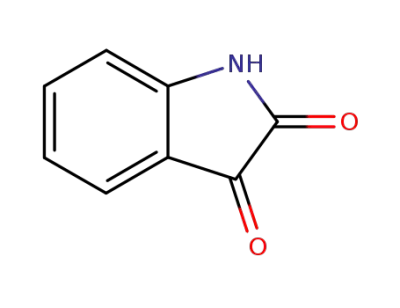
-
91-56-5,1186480-61-4,84788-92-1
indole-2,3-dione

-

-
1663-45-2
1,2-bis-(diphenylphosphino)ethane

-
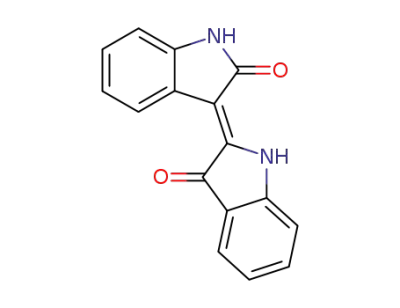
-
479-41-4
indirubin
-
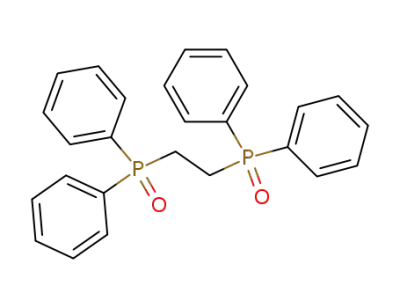
-
4141-50-8
1,2-bis(diphenylphosphinoyl)ethane
| Conditions | Yield |
|---|---|
|
In
tetrahydrofuran;
for 2h;
Reflux;
|
75%
|
-

-
120-72-9
indole
-
-
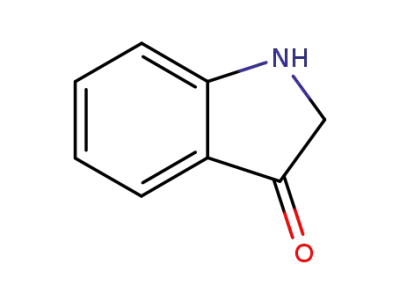
3260-61-5
indolin-3-one
-
-
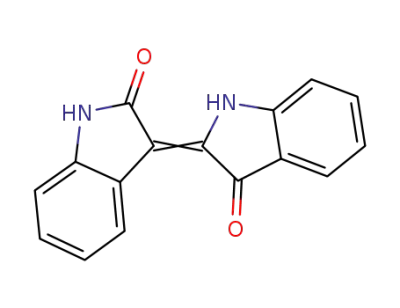
479-41-4
indirubin
-
-
91-56-5,1186480-61-4,84788-92-1
indole-2,3-dione
-
-
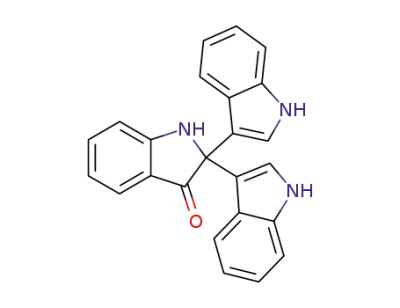
17646-95-6
2,2-di(3-indolyl)-3-indolone
-
-
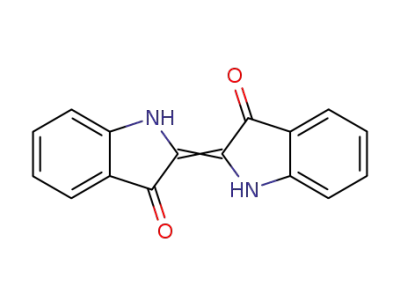
64784-13-0,482-89-3,141901-19-1,12626-73-2
indigo
| Conditions | Yield |
|---|---|
|
With
dihydrogen peroxide; 3-chloro-benzenecarboperoxoic acid;
In
ethanol;
at 20 ℃;
for 0.333333h;
|
20 %Spectr.
20 %Spectr. 10 %Spectr. 7 %Spectr. 9 %Spectr. |
479-41-4 Upstream products
-
59-48-3
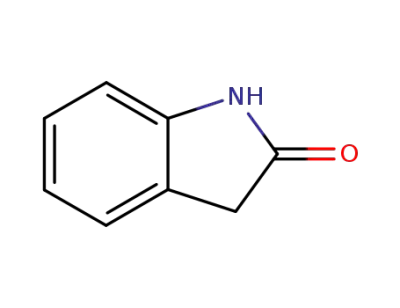
2-oxoindole
-
612-54-4
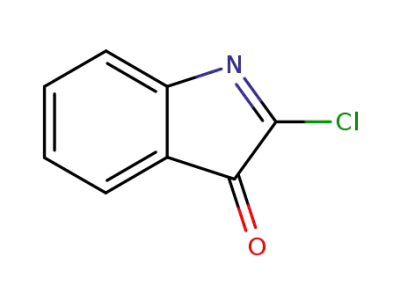
2-chloro-3H-indol-3-one
-
71-43-2

benzene
-
607-28-3
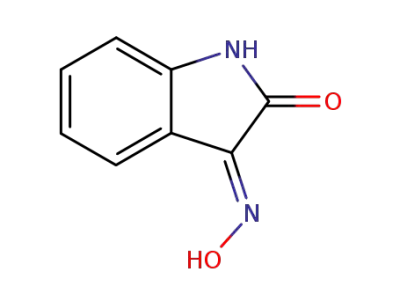
(E)-1H-indole-2,3-dione 3-oxime
479-41-4 Downstream products
-
82349-14-2
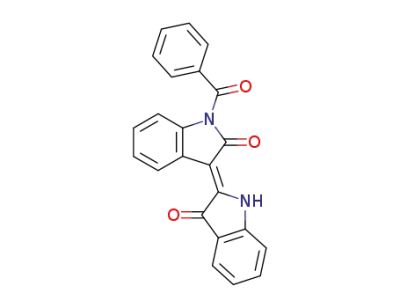
(Z )-1'-benzoyl-1H ,1'H -[2,3']biindolylidene-3,2'-dione
-
160807-49-8
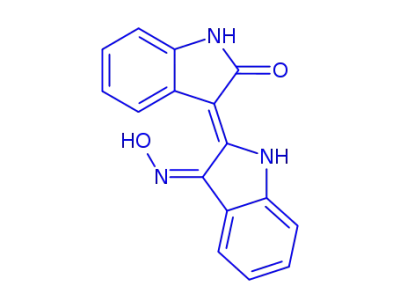
indirubin-3'-monoxime
-
667463-82-3
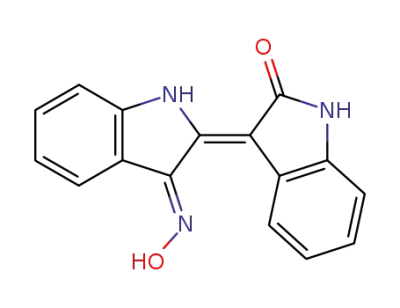
indirubin-3'-monoxime
-
91-56-5
indole-2,3-dione